
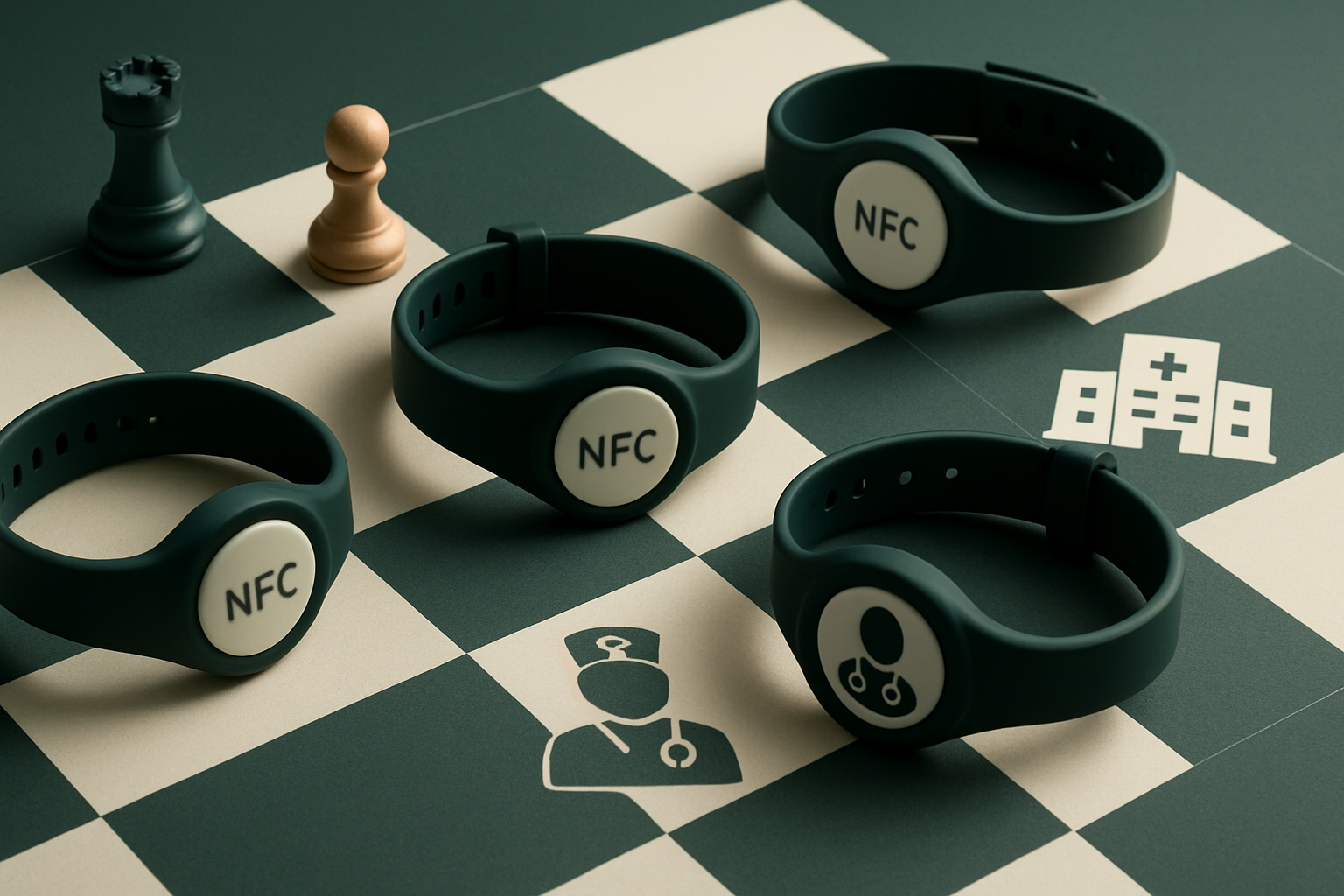
NFC (Near Field Communication) bracelets are increasingly used in various sectors due to their ability to store and transfer data quickly and securely. In the medical field, these devices offer innovative solutions for patient management and data security.
In hospitals, the integration of NFC bracelets can transform the way care is administered and monitored, while improving operational efficiency and patient safety. This article explores the different applications and benefits of NFC bracelets in healthcare facilities.
Improving Patient Management
In the hospital sector, the safety and efficiency of care are paramount. Rapid and secure identification of patients is essential to avoid medical errors. NFC bracelets provide an innovative solution by enabling immediate and contactless identification of patients. Each bracelet contains a unique identifier that, when scanned by medical staff, instantly displays essential patient information. This reduces the risk of human error and ensures that each patient receives the correct treatment.
Real-time tracking of administered treatments is another significant advantage of NFC bracelets. By integrating these bracelets into the care management system, hospitals can record every medical intervention, every medication administered, and every examination performed. This real-time traceability ensures that all steps of treatment are followed correctly. It also facilitates the updating of medical records, thus ensuring seamless continuity of care.
Easy access to medical information is crucial for hospital staff. NFC bracelets allow authorized personnel to quickly access relevant medical data directly from the patient's wrist. This speeds up the decision-making process, especially in emergency situations where every second counts. By using a secure and encrypted system, only authorized individuals can view and update the data, thus ensuring the confidentiality and security of sensitive information.
Custom NFC bracelets for hospitals can be tailored to the specific needs of each facility. They offer flexibility in terms of design, color, and functionality, allowing them to align with the internal protocols of hospitals. To learn more about the available options, visit our page on [custom NFC bracelets for hospitals](https://timelapse-3d.com/bracelet-nfc-jetable-personnalise.php).
In conclusion, the integration of NFC bracelets in hospitals transforms patient management. It brings enhanced security, operational efficiency, and an overall improvement in the quality of care. These connected devices are a major advancement towards a more modern and safer hospital management.
Optimizing Hospital Processes
NFC bracelets transform the way hospital processes are managed. Their ability to automate administrative tasks significantly reduces patient wait times. By integrating these devices, hospitals can digitize and automate patient registration, information verification, and medical record management. This frees up staff from repetitive tasks and allows them to focus on patient care, thus increasing overall efficiency.
Managing hospital beds and resources is a constant challenge. NFC bracelets facilitate this management by providing real-time data on bed occupancy and equipment usage. The collected information allows for quick and accurate reallocation of resources, avoiding bottlenecks. Thus, hospitals can optimize their capacity and improve their responsiveness to emergencies.
Communication between different hospital departments is essential for effective care. NFC bracelets promote better coordination by ensuring the instant sharing of relevant information between departments. For example, patient data can be immediately updated and accessible by the concerned services, reducing the risk of errors and communication delays. This interconnectivity allows for smoother and faster patient care.
The deployment of NFC bracelets in hospitals can be customized to meet the specific needs of each facility. Options such as disposable and personalized NFC bracelets [are available](https://timelapse-3d.com/bracelet-nfc-jetable-personnalise.php) to ensure a perfect fit for the hospital environment. These tailored solutions ensure a seamless and effective integration of NFC technologies into existing processes.
Data Security and Confidentiality
Protecting patients' personal and medical data is a priority in the hospital environment. NFC bracelets offer a secure solution for managing this sensitive information. Thanks to NFC technology, data is stored securely and is only accessible to authorized individuals.
Access to medical records via NFC bracelets is strictly controlled. Only healthcare professionals with the necessary rights can view and modify patients' medical information. This system significantly reduces the risk of human error and ensures the confidentiality of data.
The NFC technology used in these bracelets helps prevent unauthorized access. Each bracelet is associated with a unique identifier, allowing for tracking of all interactions with the medical record. This limits the risks of medical fraud and ensures that only authorized individuals can access the information.
In the event of an unauthorized access attempt, the system can immediately alert the relevant staff. This responsiveness is crucial for protecting sensitive patient data and maintaining a high level of security in hospitals.
NFC bracelets are designed to be secure and easy to use. They integrate naturally with existing hospital information systems. This allows for a smooth transition to digital data management while enhancing the security of patients' personal information.
Concrete Examples of Use
In several hospitals, NFC bracelets have been successfully integrated to improve various aspects of patient care. A notable example is Saint-Jacques Hospital, which adopted these bracelets for patient identification and treatment tracking. Thanks to this technology, medical staff can now instantly access essential patient information, thereby reducing the risk of errors during medication administration.
A case study conducted at Saint-Jacques Hospital revealed a significant decrease in medical errors since the implementation of NFC bracelets. Before adopting this technology, treatment errors due to misidentification of patients were a problem. The use of bracelets has reduced these errors by over 30%, ensuring that each patient receives the right treatment at the right time.
At Marseille Hospital, NFC bracelets have been used to optimize patient flow management. By simply scanning the bracelet, staff can verify the patient's identity, medical history, and upcoming appointments. This has reduced wait times for consultations and interventions, thus improving the overall patient experience at the hospital.
Feedback from medical staff on the effectiveness of NFC bracelets is generally positive. Nurses and doctors at Marseille Hospital have noted that these devices have simplified their daily work. They particularly appreciate the speed and accuracy with which they can access medical records without having to handle paper documents, reducing the risk of cross-contamination.
In another example, Saint-Jean Hospital has integrated NFC bracelets for managing access to sensitive areas. Personalized bracelets effectively control who can enter operating rooms or intensive care areas, thereby increasing the safety of patients and staff. This use has strengthened security protocols while simplifying access management.
The results observed in these hospitals demonstrate the positive impact of NFC bracelets on the quality of care and operational efficiency. By reducing medical errors and improving process management, these devices contribute to a safer and more efficient hospital environment. To learn more about the available options, you can check out the [custom NFC bracelets for hospitals](https://timelapse-3d.com/bracelet-nfc-jetable-personnalise.php).
Adopt NFC Bracelets in Your Hospital
Discover how our NFC bracelet solutions can transform the management of your healthcare facility.
FAQ
How do NFC bracelets improve patient safety?
NFC bracelets improve patient safety by allowing immediate and contactless identification through a unique identifier. This reduces medical errors by ensuring that each patient receives the correct treatment.
What is the typical lifespan of an NFC bracelet in a hospital setting?
The typical lifespan of an NFC bracelet in a hospital setting is not specified in the guide.
Can NFC bracelets be used to track patient movements?
The guide does not specifically mention tracking patient movements, but it highlights real-time tracking of administered treatments through NFC bracelets.