
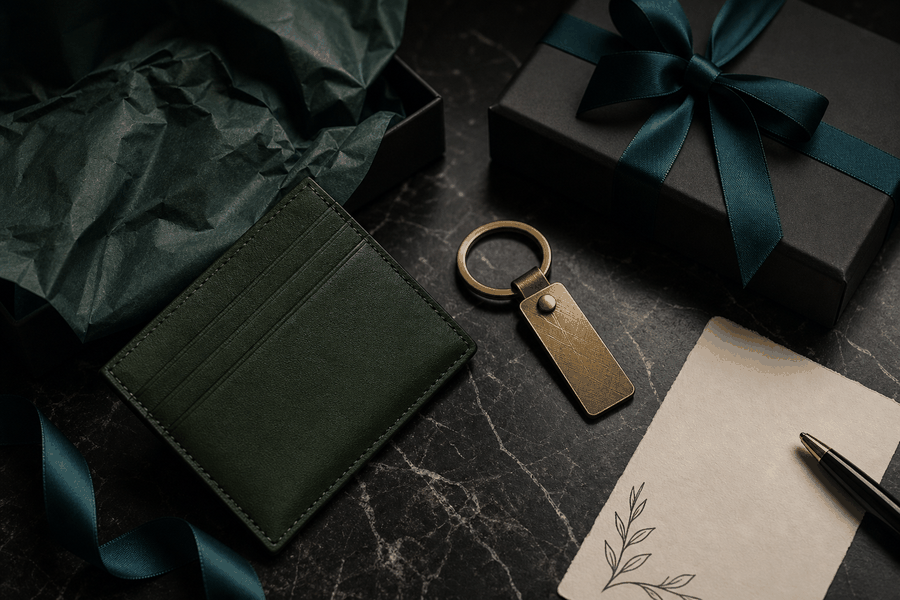
Mass distribution has its role — but with decision-makers, key accounts or strategic partners, it is counterproductive: a $2 gadget handed to an executive sends a message of low regard. Premium reverses the logic: fewer recipients, more value per item.
This guide covers the codes of premium corporate gifts: materials, manufacturing, individual personalisation, packaging — and the differentiator of the current generation: the discreet connected layer that extends the object into an experience.
What makes premium: material, craftsmanship, detail
High-end quality is recognised at first touch: the weight of solid metal, the grain of genuine leather, the precision of an engraving. Three material families dominate: metal (brass, brushed stainless steel, anodised aluminium), fine leather and wood, crafted glass and ceramics.
Local manufacturing has become a premium marker in its own right: an object made in Provence or in France carries a story that imports cannot tell — and naturally resonates with a CSR-minded audience.
| Category | Example items | Indicative budget / unit |
|---|---|---|
| Premium desk items | Engraved metal pen, leather notebook, wooden phone stand | $15 to $60 |
| Leather goods | Leather card holder, leather and metal keyring | $20 to $80 |
| Experience gift box | Local gift box (gastronomy, craftsmanship) + engraved item | $50 to $150 |
| Bespoke limited edition | Object designed for the brand, numbered | $80 to $300 |
Individual personalisation: the true luxury
Mass-market premium does not exist. What sets a high-end gift apart is personalisation for the recipient: their name engraved, a limited-edition serial number, a handwritten note, a colour chosen for them.
Laser engraving and UV printing now make this unit-level personalisation possible without inflating costs — including on runs of 20 or 50 pieces intended for a select circle of key clients.
Packaging: half the effect
A premium item in a kraft envelope loses half its perceived value. The unboxing is part of the gift: rigid box, custom-fit padding, tissue paper, personal note. Allow 10 to 20% of the item budget for packaging — it is the investment with the best emotional return.
Connected premium: the discretion that extends the object
On a high-end item, technology must be invisible: an NFC chip embedded in the leather, under the wood or within the metal — no unsightly markings. On scanning, the recipient discovers an extra touch: a video message from the CEO, exclusive content, a dedicated concierge service, a private invitation.
For the company, this layer adds what classic luxury never had: a usage signal. Knowing that the gift handed over six months ago is still being scanned means knowing the relationship is alive — and the Timelapse-3D back office measures it without intrusion.
- Invisible NFC chip, integrated during manufacturing
- Premium landing page with a dedicated design
- Evolving content: invitations, private content, concierge services
- Discreet usage signal for your sales teams
Calculating the impact: the key-account logic
The ROI of premium is not measured in volume but in relationships: a $120 gift box offered to 30 strategic accounts represents $3,600 — the cost of half a page of advertising, for an incomparably greater memory impact on the people who sign your contracts.
Set the recipient list before the budget, never the other way round: it is the relevance of the target that makes a premium item profitable.
A premium gift worthy of your key accounts?
Timelapse-3D designs high-end items manufactured locally, personalised one by one and connected with complete discretion.
FAQ
What budget for a premium corporate gift?
From $15 for an engraved premium desk item to $300 for a bespoke limited edition. The right approach: first define the list of strategic recipients, then calibrate the budget per person.
Which materials should you favour for a premium gift?
Solid metal (brass, stainless steel), genuine leather, fine woods, glass or ceramics — crafted with refined personalisation (laser engraving, hot stamping) and careful packaging.
Is French manufacturing a real selling point?
Yes: local provenance has become a premium and CSR marker. An object made in Provence carries a differentiating story, particularly valued in B2B.
How do you integrate NFC without spoiling a luxury item?
The chip is integrated invisibly (in the leather, under the wood, within the metal) and opens a dedicated premium page: personal message, exclusive content, invitation. No visible technical markings.