Two identical objects can convey radically different images depending on their branding: a screen-printed logo that flakes off cheapens the brand, while a crisp laser engraving elevates it. The personalisation method is a strategic choice, not a technical detail.
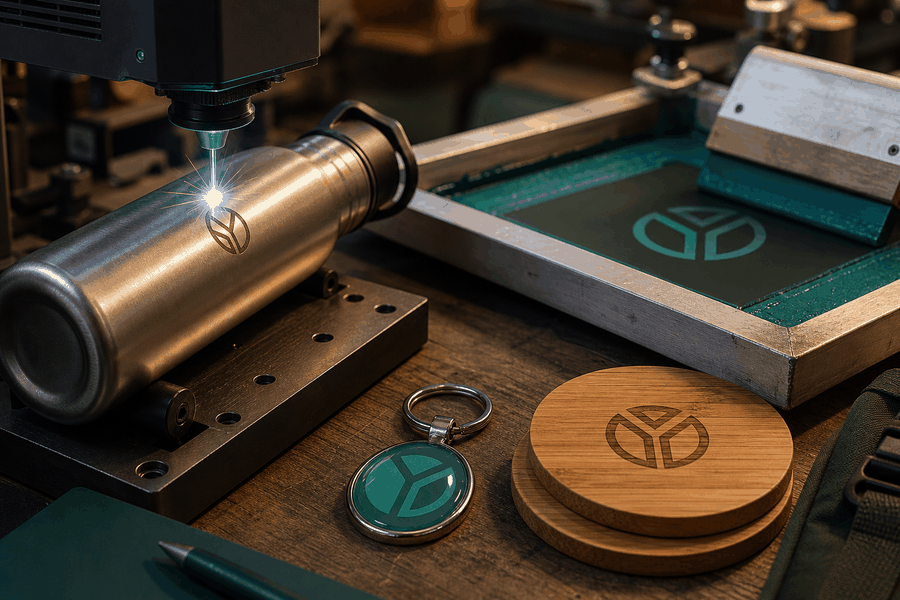
This guide compares the seven main techniques — screen printing, pad printing, laser engraving, UV printing, sublimation, doming and embroidery — with their costs, finishes and the objects they suit.
The 7 techniques compared
Each method has its own playing field: surface type, minimum quantity, number of colours, durability. This table sums up the essentials.
| Technique | Ideal for | Strengths | Limitations |
|---|---|---|---|
| Screen printing | Textiles, flat surfaces, large runs | Vivid colours, low cost at volume | Fixed cost per colour, simple surfaces only |
| Pad printing | Pens, small curved objects | Precision on small surfaces | Limited branding area |
| Laser engraving | Metal, wood, stainless steel (bottles, metal pens) | Permanent, premium finish | Single colour (the material's own shade) |
| UV printing | Plastic, glass, metal, varied shapes | Full colour, fine detail, small runs | Less resistant to heavy abrasion |
| Sublimation | Mugs, polyester textiles | 360° photo visuals, unlimited colours | Light-coloured polyester/coated ceramic only |
| Doming | Stickers, keyrings, magnets, pins | Glossy 3D relief, high-end effect | Extra unit cost, limited formats |
| Embroidery | Thick textiles (polos, caps, blankets) | Durable, perceived quality | No gradients, cost per stitch count |
Choosing by object: the right reflexes
For a plastic pen: pad printing. For a metal pen or bottle: laser engraving. For a mug: sublimation for rich visuals, screen printing for a simple logo. For textiles: embroidery for premium, screen printing for volume. For a keyring or magnet: UV printing with doming for the raised effect.
That is in fact the signature finish of Timelapse-3D NFC media: the UV-printed visual, protected by a transparent resin dome, gives the glossy domed look that distinguishes our connected keyrings, magnets and stickers.
How much does branding cost?
Branding is billed in two parts: fixed technical costs (creating the film, the screen or the programme, from $20 to $80 depending on the method) and the unit cost (from $0.10 to $1.50 per piece per colour).
The direct consequence: the larger the run, the more the fixed cost is diluted. For small runs, favour methods with low fixed costs — UV printing and laser engraving — which remain economical from 25 pieces.
Preparing your files: avoiding back-and-forth
Always supply a vector logo (AI, EPS, SVG or vector PDF): it is the format every workshop requires for a sharp result at any size. An enlarged low-resolution PNG will produce blurry edges, whatever the method.
Specify colours as Pantone references for screen printing and pad printing. For laser engraving there is no colour choice: the result is the exposed material itself (silver on stainless steel, light wood on bamboo).
Branding + NFC: personalisation becomes interactive
The branding dresses the object; the NFC chip connects it. The two combine: a premium doming visual on the front, an invisible chip on the back, and the object becomes both beautiful and measurable — every scan opens the page you manage from the back office.
Not sure which method suits your project?
Send us your logo and the target object: Timelapse-3D recommends the right branding technique and quotes your run.
FAQ
Which branding technique is the most durable?
Laser engraving: the logo is cut into the material and can neither fade nor flake off. Embroidery is its equivalent for textiles.
What is doming?
A dome of transparent polyurethane resin poured over the printed visual, creating a glossy 3D relief effect and protecting the print. It is the signature finish of Timelapse-3D NFC keyrings and stickers.
Which branding method for small quantities?
UV printing and laser engraving, which have almost no fixed costs, remain profitable from 25 pieces. Screen printing only becomes worthwhile from a few hundred.
Which file format should I supply for branding?
A vector file (AI, EPS, SVG, vector PDF) with the Pantone references of your colours. Low-resolution PNG/JPG files produce blurry edges.