
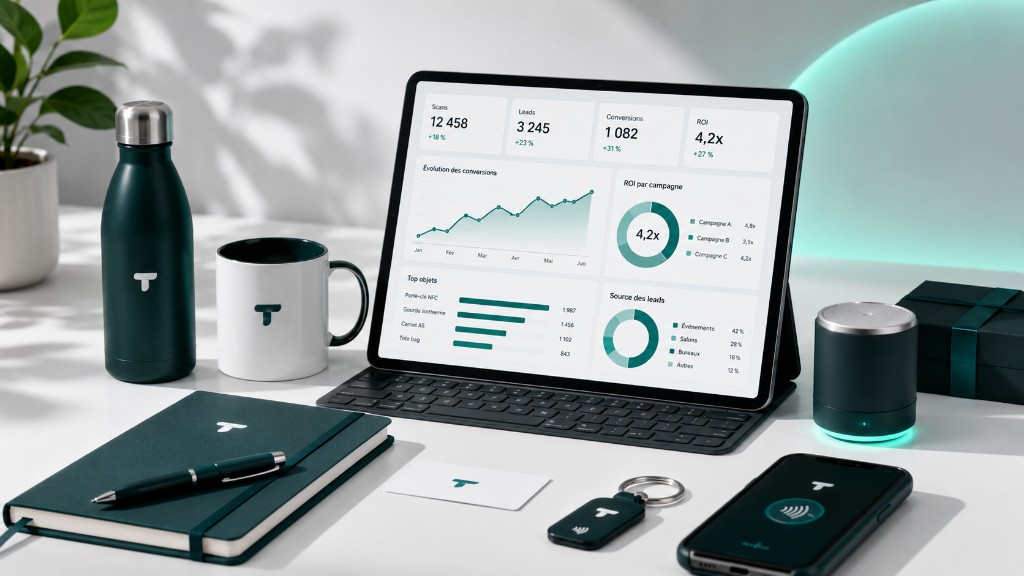
The ROI of an advertising item has long been difficult to measure. We knew how much the campaign cost, but rarely what it brought in.
With an NFC chip, a dynamic QR and a tracked landing page, the object becomes measurable: scans, leads, reviews, appointments, sales or commercial opportunities.
The basic formula
Start by adding up all the costs: production, design, customization, logistics, landing page, configuration and monitoring.
Then compare these costs to the attributable results: leads, revenue, reviews, appointments or repeat purchases.
| Element | Example | How to follow it |
|---|---|---|
| Campaign cost | $3,000 | Quote + production |
| Scans | 1,200 | NFC back office |
| Leads | 180 | Form / CRM |
| Sales | 25 | CRM / attribution |
KPIs to follow
Don't limit yourself to the number of items distributed. This number measures effort, not result.
Useful KPIs are scan rate, conversion rate, cost per lead, opportunity value, and repeat interactions.
How to improve ROI?
Improve the scanning call message, test several landing pages, segment campaigns and follow up with hot prospects quickly.
A connected object becomes more profitable when it is part of a complete scenario: distribution, scanning, content, form, scoring, follow-up.
Do you want to measure your next campaigns?
Timelapse-3D configures objects, links, scoring and dashboards to track ROI.
FAQ
Can we really measure an advertising item?
Yes if the object triggers a traceable interaction: NFC scan, dynamic QR, form, appointment booking or purchase.
Which KPI is most important?
It depends on the objective: cost per lead for acquisition, Google reviews for reputation, repeat purchase for loyalty.
How do I attribute a sale to a goodie?
Use campaign URLs, dedicated forms, promo codes, UTMs and CRM synchronization.