
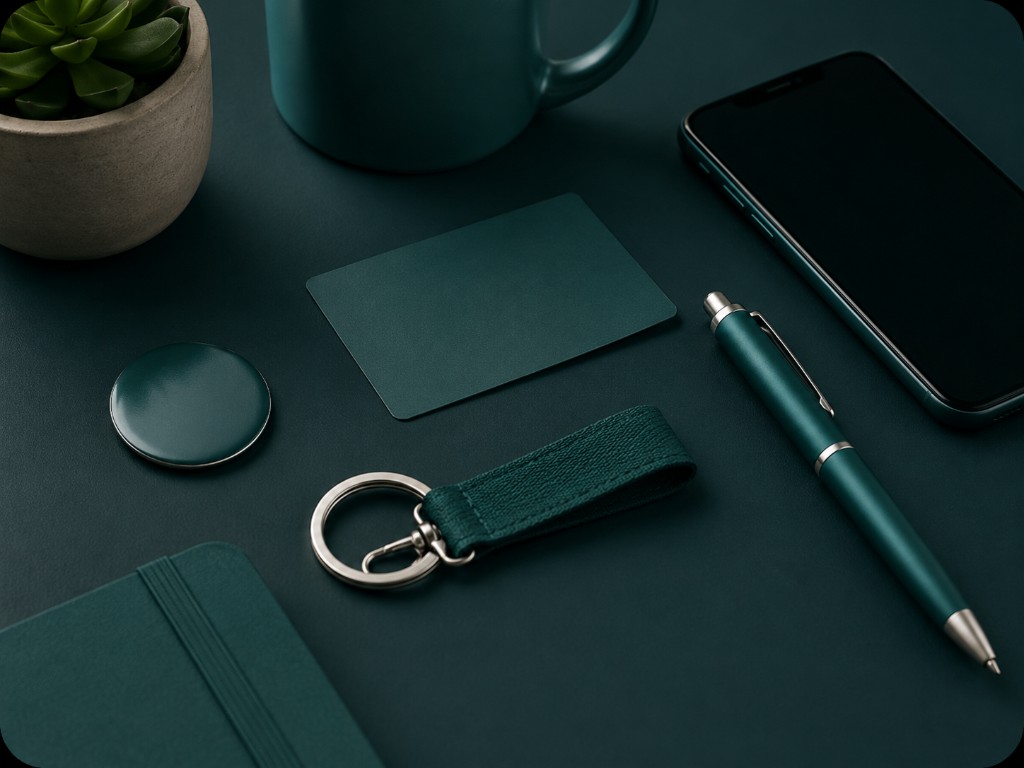
Advertising items occupy a special place in the marketing mix: they are physical, visible in everyday life and kept long after the end of a campaign. Where a digital banner disappears in a scroll, a key ring, a magnet or a card continues to broadcast a brand for weeks, sometimes months. This permanence remains their primary strength.
Their historical limit can be summed up in one word: measurement. How many scans, how many calls, how many quote requests were actually generated by the 2,000 pens ordered last year? Nobody can say. The distribution is followed, never the conversion. For a marketing department subject to budgetary decisions, this measurement hole makes the investment difficult to defend against pure digital.
It is precisely this limit that Timelapse-3D breaks down. By connecting each object to an NFC chip, an editable landing page and a tracking back office, we transform a brand medium into a measurable acquisition channel. The object remains tangible, desirable and conserveable, but it also becomes traceable, controllable and optimizable. This pillar guide explains how to choose your promotional items, which formats to favor, how to avoid classic mistakes and why the new generation of connected media is permanently changing the rules.
What is an advertising item?
An advertising item is a physical medium distributed to prospects, customers or partners to convey a brand message. It can be very utilitarian (pen, tote bag, water bottle), more statutory (leather notebook, gift box, tailor-made object) or very targeted (event badge, NFC business card, Google review plaque). The format changes, the intention remains the same: to create a tangible point of contact between a brand and a person.
In practice, we encounter several terms which designate approximately the same reality: goodies, promotional gifts, promotional items, advertising items, advertising items. Each expression has its nuance. The goodies evoke volume distribution at a trade show. Promotional gifts refer to relational attention towards an important customer. Promotional items are often attached to a one-off commercial operation. They all belong to the large family of branded physical media.
The objective of an advertising item is never to “look pretty with a logo”. It’s about triggering something: being remembered, triggering a scan, facilitating a face-to-face exchange, capturing a Google review, qualifying a contact or simply maintaining a relationship. When this objective is clearly stated before the creative brief, the right support almost takes care of itself.
Why do promotional items remain effective?
At a time when digital budgets are exploding, some are surprised that companies continue to invest in tangible things. The answer is in a few words: a well-chosen object lives in the target's daily life. It is not filtered by an ad-blocker, not forgotten the next time the feed is refreshed, not buried in a saturated mailbox. It stays on the desk, in the bag, on the fridge, in the car, hanging on a set of keys.
This physical presence multiplies repeated exposures. Seeing a logo multiple times a day on a keychain for six months creates more familiarity than a banner seen just once. Memorization progresses, and with it the probability of being consulted at the time of a breal need. This is what marketers call the mental salience effect, or more simply the “top of mind”.
Added to this memory base is an emotional effect that is often underestimated: receiving a useful object is a pleasure. The gesture of handing over a card, a magnet or a box creates a particularly valuable human touch point in a very digital sales journey. And when the object is connected, it integrates properly into the marketing stack: scan, landing, form, CRM, scoring, follow-up. No more disconnect between offline and online.
| Advertising asset | Effect observed | Compared to digital alone |
|---|---|---|
| Physical presence | Visible in everyday life | No ad-block, no filter |
| Lifespan | Several weeks to several months | Banner seen once |
| Memorization | Repeated and tangible | Volatile, fragmented |
| Gift effect | Positive emotion | Often neutral, even intrusive |
| On/offline complementarity | Bridge to digital via NFC | Closed marketing loop |
The main types of promotional items
The catalog of advertising media is large. Rather than list everything, here are the nine families most used by B2B and local companies, with for each the distribution context, the business interest and the way to make them connected with Timelapse-3D.
Advertising key rings
The key ring is undoubtedly the most preserved advertising object on the market. Lightweight, hung on a keychain used every day, it benefits from an exceptional exposure time. It is easily offered in a salon, when signing a contract, in a welcome kit or at the end of an event. Connected via NFC, it transforms its daily presence into an active channel: a gesture of the smartphone opens a landing page, a form or a Google review sheet.
Advertising magnets
The magnet is one of the most profitable objects for local businesses, craftsmen, restaurants and home services. Placed on a refrigerator, on an electrical panel or on a metal filing cabinet, it remains visible for years. Connected, it becomes the antidote to the lost flyer: the customer scans to reserve, to report a problem, to follow up with a quote or to leave a Google review after an intervention.
Personalized badges
Badges identify and engage at the same time. At a trade show, an internal event, an HR operation or a conference, they provide a framework. The NFC version makes it an active medium: scanning opens the program, reserved content, a game, a feedback form or a speaker's file. For salespeople and receptionists, the same badge is used to receive a call-back request in one gesture.
Advertising pens
The pen remains the most widely distributed advertising item in the world. We must accept its nature: massive, not very different, but useful and accepted. Its strength lies in volume distribution. An NFC variant is starting to emerge: a cap or ring incorporating a chip which opens, after scanning, a product catalog, an interactive demo or a lead form for field salespeople.
Connected cards
The connected card, digital heir to the business card, accelerates contact sharing in B2B. Instead of distributing around twenty paper cards that are quickly forgotten, the salesperson places his NFC card against the person's phone: profile, contact details, appointment booking, presentation video, brochure, everything opens immediately. For field teams, this is a real productivity gain.
Google review plates
The Google review board solves a concrete problem: satisfied customers forget to leave a review. Placed at the checkout, at reception, on a table or at the end of an intervention, it invites the customer to approach their smartphone. The Google listing page opens immediately, withoutresearch, without application. Over a few months, the effect on the average rating and the volume of reviews becomes visible.
Connected medals
The connected medal is used in sport, events, training and certain premium courses. Beyond the symbol, it becomes the key to a digital experience: personal photo album, souvenir video, ranking, certificate, winner's message, social sharing. For a race organizer or sports brand, it extends the event well beyond the finish line.
Premium customer gifts
For VIP customers, important partners or the end of the year, a low-end object degrades more than it enhances. A premium box, a tailor-made object, a leather notebook or a neat local product convey an image of consideration. Coupled with an NFC card or a personalized digital message, they extend the gesture: video thank you, access to a VIP service, invitation to a private event.
Event promotional items
Events – trade shows, launches, conferences, evenings – have their own dedicated supports: badges, lanyards, bracelets, bags, stand goodies. Well thought out, they serve both logistics (identification), communication (partner logos) and data collection (scan = lead). Poorly thought out, they are thrown in the trash as soon as they leave the parking lot.
How to choose an advertising item?
The right choice is not made by browsing a catalog. It is done from a clear intention. Too many companies still order the “fashionable” item without asking a single useful question upstream. Here is a simple seven-step method that avoids most errors: 1) define the objective of the campaign, 2) precisely identify the target who will receive the object, 3) choose the format adapted to this use, 4) adapt the personalization to the brand, 5) plan the digital journey after receipt, 6) measure the results, 7) optimize the following campaign.
The goal determines everything else. Depending on whether you are looking for pure awareness, qualified acquisition, loyalty, customer reviews, sponsorship, activation of a trade show, a product launch or commercial animation, the optimal support changes radically. A Google review plaque has no place in an employee welcome kit, and an event medal has no meaning in door-to-door sales.
For each objective, then qualify the target in practical terms: level of equipment, context of use, sensitivity to design, expectations regarding your brand. A hot prospect met at a B2B trade show does not expect the same gift as a loyal customer for five years, who does not expect the same thing as a strategic partner. This fineness of targeting often separates an effective campaign from an average campaign.
| Objective | Recommended object type | Action triggered |
|---|---|---|
| Notoriety | Pen, tote bag, magnet | Passive memorization |
| Acquisition | Keychain or NFC card | Lead form, appointment making |
| Loyalty | NFC magnet, counter plate | Offer, sponsorship, after-sales service |
| Customer reviews | NFC plate Google review | Direct Google Review |
| Living room | NFC badge, card, key ring | Scan = qualified lead |
| Product launch | Box + NFC card | Demo, catalog, contact |
| Commercial animation | Promo magnet, NFC sticker | Pilotable temporary offer |
Classic advertising object or connected advertising object?
For thirty years, the debate did not exist: an advertising item bore a logo, period. The widespread arrival of NFC on smartphones has changed the situation. Today, many businesses compare the two options, wondering if the cost difference is worth it. The answer, honestly, depends on what you want from the campaign.
The object couldclassic blicitaire does what it has always done: display a logo, create visibility, give a gift. It is easy to order, inexpensive in volume, without technical configuration. Its limit remains the same: no data, no direct link between distribution and business results. You know how much you ordered, you don't know how much it made.
The connected advertising object adds three layers that the classic object cannot offer: an editable NFC or QR link, a dedicated landing page, a tracking back office. Added to this are the advanced uses supported by Timelapse-3D: segmentation of campaigns by salesperson or point of sale, AI contact scoring, intelligent forms, automatic triggering of Google reviews, CRM integrations. The chip alone does not make the value. It is the surrounding system that transforms an object into active media.
| Criterion | Classic object | Timelapse-3D connected object |
|---|---|---|
| Logo and visibility | Yes | Yes |
| Link after distribution | None | Editable NFC or QR link |
| Dedicated landing page | No | Yes, customizable |
| Scan tracking | No | Yes, in real time |
| Form and leads | No | Yes, integrated into CRM |
| Google reviews made easy | No | Yes, dedicated route |
| Campaign management | No | Dashboard and AI |
| Data and scoring | None | Profiles, segments, AI score |
| Modification after production | No | Yes, remote replaceable link |
Examples of use by sector
To make all this concrete, here are ten scenarios by sector, all based on observed uses or easy to transpose. The idea is to show that the same object can produce very different results depending on the scenario that accompanies it.
- Restaurant: an NFC magnet given with the bill links to the reservation page and the Google review sheet. It stays on the fridge and makes the customer come back for the next desire.
- Craftsman (plumber, electrician, landscaper): an NFC plate left with the customer after intervention opens a filtered review process, secures the Google rating and keeps in touch for a future need.
- Car dealership: an NFC key ring given with the keys to the new vehicle links to the concierge service, the digital service book and the brand's sponsorship program.
- Communication agency: a commercial NFC card shares the studio's portfolio, appointment schedule and recent references in one gesture.
- Trade show: an NFC badge worn by each salesperson transforms an exchange into a qualified lead in the CRM, with trade show context, stand and scanning schedule.
- Sporting event: a connected medal extends the race with a photo album, a personal ranking, a souvenir video and an invitation to the next edition.
- Local commerce: an NFC sticker placed at the checkout pushes a dematerialized loyalty card, a Google review or a seasonal offer that can be modified remotely.
- Multi-site franchise: the same NFC magnets distributed to 100 stores each point to the local promotion of the day, modifiable centrally by the network head.
- Training organization: an NFC learner card provides access to resources, the certificate of attendance and the post-session satisfaction questionnaire.
- Industrial: an NFC tag affixed to a machine opens the technical documentation, the after-sales service request form and the equipment's intervention history.
What budget should you plan for promotional items?
There is no single price for an advertising item. The final price depends on several parameters: quantity ordered, material chosen, complexity of personalization, finishes (varnish, engraving, gilding, packaging), presence or not of an NFC chip, sophistication of the associated landing page, deadlines and level of support. Added to this are tracking and the possible connection to the CRM, which are software investments, not unit costs.
Strictly “unit price” logic is misleading. A $0.40 item distributed en masse and 80% thrown away actually costs more to the lead than a $3 item kept, scanned and generating quote requests. The real relevant unit of measurement is the cost per useful interaction: per scan, per lead, per Google review, per business opportunity. It is this cost that must be compared between supports.
A simple reasoning framework: before looking at the unit price, ask two questions. How many actions can this item trigger in its lifetime? What value does each of these actions have for your business? This double calculation immediately gives priority to quality, usefulness and measurability, and removes the temptation of systematic low-cost.
Mistakes to avoid
Nearly fifteen years of observing goodie campaigns in B2B and retail allow us to list the recurring pitfalls. Here they are, in the order they appear in a brief.
- Choose solely on price: the cheapest rarely opens the best campaign. An equivalent budget spread over fewer, but more useful objects often gives a better result.
- Ordering without a clear objective: without explicit intention (opinions, leads, loyalty, image), no support can be judged effective. Measurement becomes impossible.
- Neglecting the quality of the support: a fragile or low-end object damages the brand image more than it serves it. Premium customers notice this immediately.
- Choose a useless object for the target: a gadget that has no place in the person's daily life ends up in the trash as soon as they return to the office.
- Forgetting the real target: thinking "what I like" rather than "what the target needs" is the most common mistake when creating the creative brief.
- Do not provide any CTA after scanning: a connected object that links to the site's home page does not trigger any action. The dedicated landing should be thought of separately.
- Send to the wrong page: slow page, unreadable on mobile, form too long, off-topic content. Every friction loses conversions.
- Not measuring performance: Without tracking scans, leads, and reviews, you'll never know what worked. You will do the same thing again the following year and hope.
- Distribute without a commercial scenario: an item handed over without reminder is only half useful. The post-distribution sequence (email, appointment, offer) often makes the difference in the final ROI.
Why choose Timelapse-3D for your promotional items?
Our job is not limited to making objects. We design complete marketing systems, where the object is only one building block of a larger system designed to convert. This starts with selecting the right support, but it also includes landing page design, NFC integration, back-office configuration, tracking, GDPR-compliant data collection, AI scoring and integrations with your existing tools.
Concretely, this gives you access to a single platform: you see each scan, each conversion, each most successful salesperson, each point of sale that takes off. You adjust links remotely without reprinting, you create centrally controlled seasonal campaigns and you finally get a clear answer to the question "what did this goodies budget bring in?".
Our commitments are simple: transparency on production and origin (manufacturing in Provence for our flagship range, STMicroelectronics chips manufactured in France), support from the brief phase, advice independent of the catalog (we do not recommend support if it is not relevant) and systematic orientation towards measurement.
- Personalized NFC objects according to the brand and target.
- Landing paresources dedicated to each campaign or support.
- NFC links modifiable remotely, without reprinting.
- Back office for tracking scans in real time.
- GDPR-compliant data collection.
- AI scoring of contacts to prioritize follow-ups.
- Campaigns can be managed by salesperson, event or point of sale.
- Acquisition, loyalty and customer review logic integrated into the same back office.
Transform your advertising objects into connected and measurable media
Describe your target, your budget and your goal. We offer you a selection of suitable NFC Timelapse-3D media, with a complete digital journey and measurable monitoring of results.
FAQ
What is an advertising item?
An advertising item is a physical medium personalized with a company logo and distributed to prospects, customers or partners. It is used to create visibility, remember the brand, maintain a relationship or trigger a measurable action, particularly in its NFC connected version.
What is the difference between goodies and promotional items?
The two terms generally mean the same thing: a physical object bearing a company logo. \"Goodies\" rather refers to volume distribution at a trade fair or event, while \"promotional object\" is a broader term which also includes customer gifts, event materials and premium tailor-made items.
What are the most effective promotional items?
The most effective media are those that are kept and used over time: key rings, magnets, NFC business cards, Google review plates. Their effectiveness is multiplied when they integrate a digital journey (NFC or QR) which transforms each use into a measurable interaction.
Which promotional item should you choose for a trade show?
For a B2B trade show, favor compact objects that facilitate networking and lead capture: NFC badges, commercial NFC cards, connected key fobs. Each of these supports allows you to open a form or sales form in one gesture, and send the lead directly into your CRM.
Can we measure the ROI of an advertising item?
With a classic object, it is very difficult. With a Timelapse-3D connected object, this is natively possible: you track the number of scans, pages viewed, forms completed, Google reviews submitted and sales attributable to the campaign. The ROI finally becomes calculable.
Why use an NFC promotional item?
NFC adds a layer of digital interaction without any friction for the user: they approach their phone, the page opens. For the company, this unlocks three key uses: change the destination at any time, create dedicated landing pages and measure each scan to manage the campaign.
What budget should you plan for a promotional item campaign?
The budget depends on the quantity, type of object, personalization and level of tracking. Rather than aiming for a unit price, think in terms of cost per useful interaction: a more expensive object that generates scans, leads and Google reviews is often more profitable than a low-cost goodie thrown away immediately.