
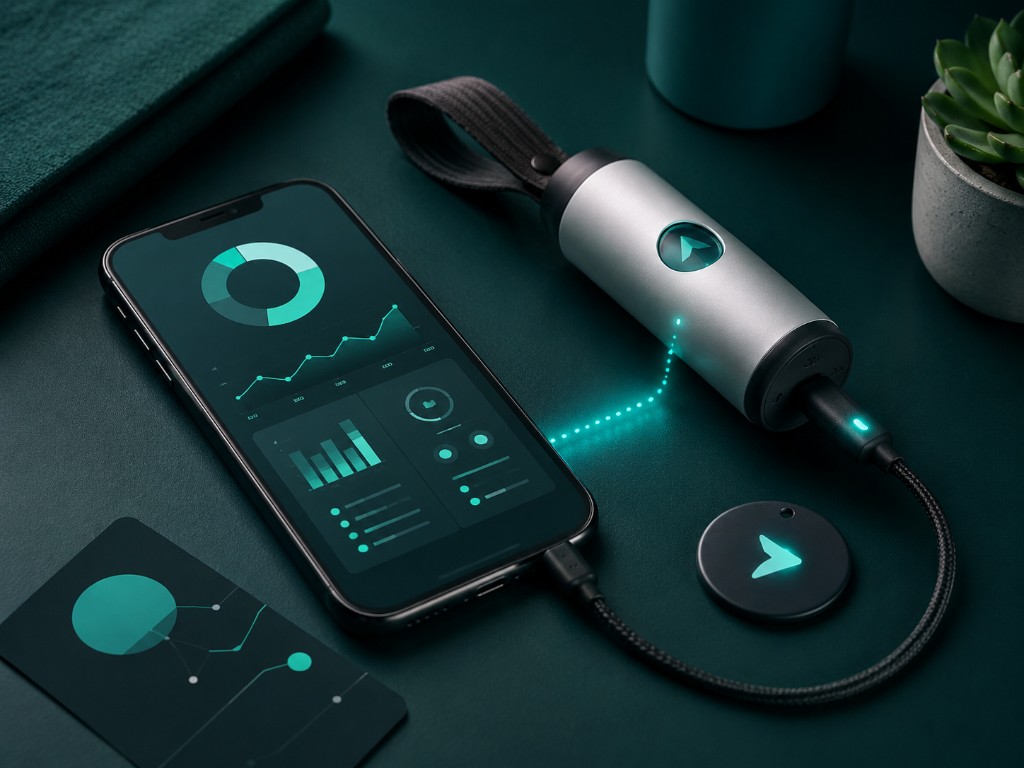
Object advertising has existed for more than a century. Free calendars, branded pens, promotional caps, corporate mugs: the basic mechanics are always the same. Distribute physical support so that the brand lives in the recipients’ daily lives. This logic remains valid, but it suffers from a historical limitation: it is almost impossible to measure.
The arrival of NFC on smartphones is a game-changer. The physical medium remains, but it becomes capable of triggering a digital interaction, opening a web page, collecting data and providing information on the performance of a campaign. This is what we call a media object: a hybrid medium between tangible advertising and digital marketing, capable of broadcasting a message, creating an interaction and measuring a result. This guide explains what is behind this idea and how to actually use it in a business.
Definition of advertising by object
Object advertising refers to the use of physical media to convey a brand message. The object can be very standard (pen, mug, tote bag), very specialized (event badge, business card, business magnet) or very premium (gift box, custom object). Whatever the format, the initial objective remains the same: to create a visible and lasting presence around the brand.
The main components are simple: a physical support, a logo, a message, organized distribution. Success then depends on several factors: quality of the support, relevance for the target, distribution context, shelf life. A successful campaign leaves a long mark in the daily lives of recipients.
The limits of traditional object advertising
Despite its relevance, object advertising has long suffered from a measurement deficit. Five limits come up again and again in discussions with marketing departments.
- Low measurability: no possible tracking of conversions, no clear attribution.
- Difficult to compare: impossible to compare the performance of an object to a digital campaign.
- Often passive communication: the object diffuses, but does not trigger any specific action.
- Conservation dependent: if the object is thrown away, the campaign stops.
- No restart possible: no channel to reactivate the target after distribution.
What is a media object?
A media object is a physical object capable of broadcasting a message, triggering an interaction and measuring performance. It no longer just carries a logo: it becomes the interface between a brand and its audience, halfway between tangible support and digital media.
Concretely, a media object combines three bricks: a physical object (key ring, magnet, card, badge, plaque, medal, etc.), scanning technology (NFC and/or QR code) and an editable digital experience (landing page, form, game, notice, profile, video). The sum of these three bricks transforms it into a marketing channel in its own right, comparable to an email, a banner or a social post.
How does a connected media object work?
The journey is simple, both for the brand and for the user. It comes in six easy-to-orchestrate steps.
- The company distributes the object to an identified target (prospect, customer, partner, employee).
- The app userremove your smartphone from support, without application or search.
- A landing page opens, designed specifically for the campaign.
- The user performs an action: fill out a form, leave a review, make an appointment, read content, take advantage of an offer.
- The data is transmitted in real time to the back office (scans, conversions, sources, media).
- The company analyzes performance, adjusts links remotely and triggers targeted reminders.
Examples of media objects
Almost all historical media can become media objects. Here are the seven most used formats today in the Timelapse-3D range.
- NFC key ring: kept on the daily keychain, ideal for loyalty and sponsorship.
- NFC magnet: placed on the fridge or an electrical panel, perfect for craftsmen, restaurants and businesses.
- NFC event badge: identifies the participant and opens the program, content or form.
- Google review plaque: captures positive emotion at the right time, increases the local rating.
- Connected card: replaces the paper business card, accelerates B2B networking.
- Connected medal: extends a sporting event or an awards ceremony with a digital experience.
- NFC pen: mass distribution object transformed into a gateway to a catalog or lead.
Why is the media object more measurable?
This is probably the biggest break. With a classic object, we roughly knew the cost of the campaign and almost never the result. With a media object, we can monitor around ten indicators with a precision comparable to that of a digital campaign.
- Number of raw and qualified scans.
- Pages viewed and average duration on the landing.
- Conversions (forms, reviews, appointments, purchases, sponsorships).
- Segmentation by campaign, event, commercial or point of sale.
- Geolocation of scans (area, city, type of location).
- Post-scan behavior (raise, return, average basket).
- Performance of reminders and opening rate of sequence emails.
- Contact AI score (intent, interest, freshness).
- Cross-media and cross-campaign comparison in the same back office.
- Calculation of direct ROI per campaign and per medium.
Object advertising and digital marketing: a more powerful combination
The opposition between offline and online has had its day. The most successful companies use both together. The media object is precisely the bridge between the two: the physical medium captures attention in real life, the digital transforms this attention into measurable action.
At a trade show, for example, the NFC badge replaces the exchange of business cards, feeds the CRM in real time and triggers a personalized email sequence upon returning to the office. In a restaurant, the NFC plate on the table captures the Google review at the right time and sends each feedback to the manager's dashboard. In a franchise, the same object distributed to 100 stores links to a different local page, modifiable centrally by the head of the network.
In each of these cases, the object without digital technology would not measure anything. Digital without the object would not capture attention at the right time. It is the combination that produces performance.
Why does Timelapse-3D talk about a new generation of goodies?
The word “goodies” itself is evolving. For decades, it designated cheap objects, distributed en masse, without tracking. Today, it is starting to designate something else: connected, measurable, modifiable media, integrated into the company's marketing stack.
This generational change is not only based on the NFC chip. It is based on the entire system around: back-office, landing pages, tracking, AI scoring, CRM integrations, configuration by salesperson or by point of sale, multi-site management, confGDPR committee. It is this ecosystem that Timelapse-3D makes available to each customer, and this is what transforms a goodie into an acquisition channel.
- Classic goodie: a logo, a distribution, little or no data.
- Timelapse-3D connected goodie: a complete acquisition channel with editable link, dedicated landing, back office and AI.
- Centralized management and local autonomy in the same tool.
- Direct ROI per campaign, per medium and per target.
Examples of possible campaigns
Seven concrete examples to visualize how the media object adapts to various contexts. All of them already exist in client companies or are easy to transpose.
- Professional trade fair: commercial NFC badge + landing lounge + real-time CRM.
- Restaurant: NFC table plate + filtered Google review route + monthly review monitoring.
- Car dealership: NFC key ring given with the keys + concierge service + digital service book.
- Sporting event: connected medal + photo album + ranking + registration for the following year.
- Sales network: nominative NFC cards + individual statistics + AI scoring.
- Communication agency: white label kit + client sub-accounts + reporting by account.
- Local commerce: NFC cash register sticker + editable offer of the month + dematerialized loyalty card.
Transform your advertising objects into connected media objects
Timelapse-3D designs objects, landing pages, tracking and CRM integrations to make each physical medium a real measurable marketing channel.
FAQ
What is object advertising?
It is the use of personalized physical media (pens, magnets, key rings, badges, boxes, etc.) to carry a brand message into the daily life of a target. Its strength is the duration and repetition of exposure, its historical limit is the absence of measurement.
What is a media object?
A physical object capable of broadcasting a message, triggering an interaction (via NFC or QR code) and measuring performance. It combines tangible support, modifiable digital experience and data collection.
What is the difference between advertising object and media object?
The classic promotional item simply carries a logo. The media object adds three layers: an editable link, a dedicated landing page and a measurement back office. It becomes a marketing channel in its own right.
How to measure object advertising?
With a classic object, it is very difficult. With a Timelapse-3D media object, you track the number of scans, pages viewed, conversions, Google reviews, appointments and direct ROI, in a single dashboard.
Why use NFC?
NFC is the most fluid technology: the user approaches their phone and the page opens, without application, without search. This lack of friction maximizes the interaction rate and makes it possible to capture reliable behavioral data.
What objects can become media objects?
Almost everything: key rings, magnets, badges, cards, plaques, medals, pens, labels, boxes. Simply integrate an NFC chip and link the scan to an editable landing page in the back office.
Does the media object replace digital advertising?
No, he completes it. Digital alone does not capture attention in the physical world, the object alone does not measure conversion. The combination of the two produces the most effective campaigns, both B2B and local.