
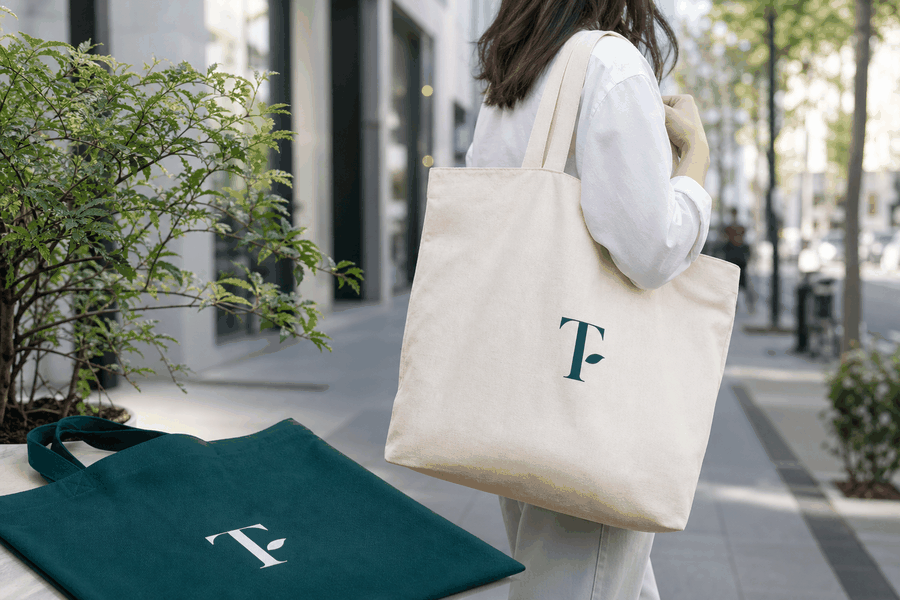
The tote bag has become the number one textile promotional item: handed out at trade shows, in shops or at events, it is reused dozens of times on average — and every outing exposes your brand to dozens of onlookers. Few media offer such a low cost per impression.
But the market is flooded with flimsy, poorly printed bags that do not survive three shopping trips. This guide covers what makes a custom tote bag people actually carry: the material, the fabric weight, the printing, the design — and the NFC layer that turns the bag into a measurable campaign medium.
Material and fabric weight: the foundation of a bag that lasts
Fabric weight (gsm) is the first criterion of perceived quality. Below 140 gsm, the bag is a disposable pouch; from 220 gsm upwards, it is a proper bag that people keep and are happy to carry.
| Material | Recommended weight | Indicative price / unit | Positioning |
|---|---|---|---|
| Standard cotton | 140 to 180 gsm | $1 to $2.50 | Wide distribution, trade shows |
| Certified organic cotton | 180 to 270 gsm | $2.50 to $5 | Credible CSR image, retail |
| Recycled cotton / RPET | 200 to 300 gsm | $2 to $4.50 | Circular-economy messaging |
| Jute or heavy canvas | 250 gsm and up | $3 to $7 | Premium, client gifts |
The design that makes people carry the bag
A counter-intuitive rule: the less intrusive your logo, the more the bag gets carried. The most-used tote bags are those whose artwork is perceived as attractive — an illustration, a clever message, a graphic collaboration — with the brand as a discreet signature.
Think of the bag as a product people would choose, not as a banner. A beautiful design multiplies the bag's outings, and therefore your brand's exposure: it is simple maths.
Screen printing or transfer: choosing the right print method
Screen printing remains the benchmark on textiles: dense colours, excellent wash resistance, costs that fall with volume. Digital transfer (DTF) enables multicolour photo-quality artwork with no fixed cost per colour, ideal for short runs.
On dark cotton, plan for a white underbase when screen printing. And always insist on a physical proof for a first run: colours render differently on canvas than on screen.
The connected tote bag: from bag to acquisition channel
A sewn-in NFC label or a heat-applied patch links the bag to a page you control: prize draw, loyalty programme, new collection, Google reviews. The carrier — and anyone they cross paths with — can scan it.
For a retail brand, it is a formidable scenario: the bag handed out at the till brings the customer back to the offer of the month, and every scan is counted in the Timelapse-3D back office. The bag stops being a cost and becomes a measurable medium.
- Discreet NFC label sewn into the hem or printed patch
- Editable link: the bag's campaign evolves all year round
- Geolocated scans and statistics per distributed batch
- Printed QR code available as a complement
How much does a tote bag campaign cost?
For 500 organic cotton 220 gsm bags screen-printed in 1 colour, expect $1,500 to $2,200 depending on the finish. The cost per use becomes negligible as soon as the bag is carried regularly: it is one of the best visibility-to-price ratios in the promotional products market.
The NFC option adds roughly $0.50 to $1 per bag — compare that with the cost of a digital advertising click, bearing in mind that here every scan is a physical contact already engaged with your brand.
A tote bag your customers will actually carry?
Timelapse-3D advises you on the right material, fabric weight and printing — and can connect your bags with NFC to measure the campaign.
FAQ
How much does a custom tote bag cost?
From $1 per unit in standard cotton for large runs to $7 for premium heavy canvas. Screen-printed 220 gsm organic cotton, the best compromise, sits between $2.50 and $5 depending on quantity.
What fabric weight should you choose for a tote bag?
At least 180 gsm for a credible bag, ideally 220 to 270 gsm for a durable, brand-enhancing one. Below 140 gsm, the bag is perceived as disposable.
Organic cotton or recycled cotton?
Certified organic cotton (GOTS) supports a CSR narrative; recycled cotton or RPET tells a circular-economy story. Both are credible: choose according to your brand message.
How do you make a tote bag connected?
With a sewn-in NFC label or a heat-applied patch linked to an editable page (game, loyalty, offer). Scans are tracked in the Timelapse-3D back office.