
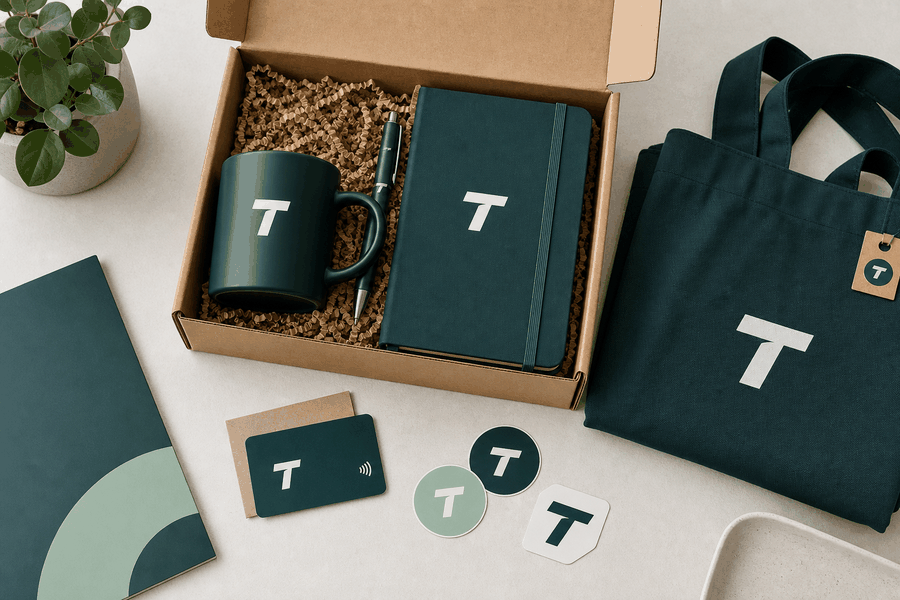
An employee who experiences a good onboarding is far more likely to stay: the first weeks shape long-term engagement. The welcome pack is only one piece of that puzzle, but it is the most tangible one — the one that gets photographed, shown around and posted on LinkedIn.
This guide details how to build an effective welcome pack for your budget, the common mistakes, and the connected version: a pack where each object can open the tools, contacts and content the new joiner needs.
What should go into a welcome pack?
The golden rule: objects that are genuinely useful in day-to-day work and consistent with your culture. A pack of mismatched gadgets sends the opposite message to the one intended.
| Tier | Budget / pack | Typical contents |
|---|---|---|
| Essential | $15 to $30 | Mug or water bottle, notebook, pen, logo stickers |
| Comfort | $30 to $70 | + tote bag or backpack, blanket or cap, NFC welcome card |
| Premium | $70 to $150 | + quality embroidered apparel, tech item (power bank, NFC carabiner), local gift box |
The mistakes that sink a welcome pack
Three pitfalls come up time and again: quantity over quality (eight mediocre items instead of four good ones), an oversized logo plastered everywhere (the employee is not a billboard), and forgetting sizes or preferences for apparel.
The fourth pitfall is more subtle: a beautiful pack handed over in a disorganised onboarding. The object cannot make up for the process — it has to embody it.
The connected welcome pack: onboarding becomes an experience
This is where Timelapse-3D stands out: embedding an NFC card or object in the pack transforms the welcome. On the first scan, the new joiner opens their welcome space: a word from the CEO, the team directory, links to the tools, a practical FAQ, the first-week schedule.
On the HR side, the back office shows which packs have been activated — a simple signal to check that onboarding is off to a good start, site by site, intake by intake.
- NFC welcome card: scan → the new joiner's personalised welcome page
- Editable content: the page evolves over the weeks (day 1, day 7, day 30)
- Activation tracking by site or by recruitment intake
- Reusable: the same card later serves as an internal business card
Welcome pack and employer branding: the LinkedIn effect
A successful welcome pack is invariably photographed and shared by new employees. It is a free recruitment channel: every "first day" post exposes your employer brand to hundreds of profiles similar to the one you have just hired.
So take care of the unboxing: a clean box, a note personalised with their first name, a simple presentation. The extra cost is minimal, the effect multiplied.
Build a welcome pack your new hires will talk about
Timelapse-3D assembles your onboarding kit: useful objects, careful personalisation and an NFC welcome card linked to your welcome space.
FAQ
What budget should you plan for a welcome pack?
From $15 for an essential kit (mug, notebook, pen) to $150 for a premium pack with embroidered apparel and tech items. The average observed in France is between $30 and $70.
What should go into an onboarding kit?
Objects useful in day-to-day work: a mug or water bottle, notebook, pen, tote bag, and ideally an NFC welcome card that opens the new joiner's digital welcome space.
What does a connected welcome pack add?
Scanning the NFC card opens a personalised welcome page (team, tools, schedule). HR can see which packs have been activated and the content evolves throughout the onboarding.
Should the logo go on every item?
No. Subtle, quality branding gets worn and used far longer than an oversized logo. The goal is for the employee to actually want to use the items.