
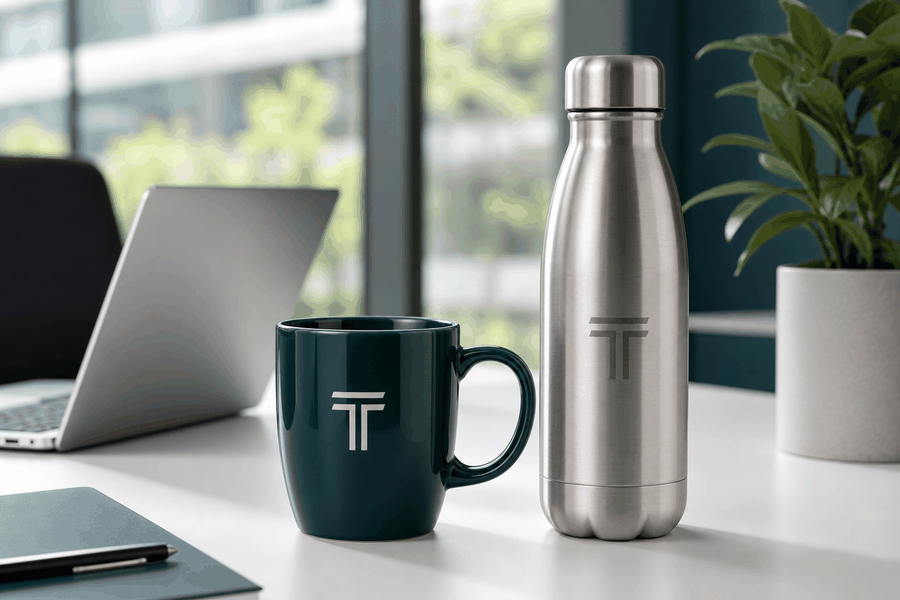
The mug and the water bottle share a rare quality among promotional items: they are used every day, for years, often in front of colleagues, clients or partners. Every coffee break becomes brand exposure.
This guide covers the selection criteria (materials, printing, capacity), typical prices, and how to add a digital layer — an NFC sticker under the base, a QR code on the packaging — to link the object to a measurable action.
Mug or water bottle: which one for which audience?
The mug lives at the office, the bottle travels. The former targets desk-based teams and B2B clients, the latter suits people on the move, athletes and outdoor events.
| Criterion | Custom mug | Branded water bottle |
|---|---|---|
| Place of use | Office, home | Commuting, sport, field work |
| Average lifespan | 2 to 5 years | 3 to 6 years |
| Indicative price | $2 to $8 | $4 to $15 |
| Brand image conveyed | Friendliness, everyday life | CSR, health, mobility |
| Branding area | Large (360° possible) | Medium, vertical |
Materials and printing: what makes the quality
For mugs: ceramic (a classic, dishwasher-safe with vitrified printing), glass, or bamboo for the CSR angle. For bottles: double-wall stainless steel (insulated, premium), aluminium (light, economical) or Tritan (transparent, BPA-free).
On the printing side, sublimation allows full-colour 360° visuals, screen printing guarantees long-lasting colours, and laser engraving on stainless steel delivers a high-end finish that never fades.
The eco-friendly angle: an argument that now tips the scales
The reusable bottle has become the symbol of the fight against plastic bottles: giving one associates your brand with a tangible gesture. Mugs replace disposable cups at the office — some companies roll them out as a fully-fledged internal CSR initiative.
Beware of greenwashing, however: an eco-friendly object has to last. Favour quality (stainless steel, thick ceramic) and European manufacturing where possible.
Connecting a mug or a bottle: yes, it is possible
A discreet NFC sticker under the base of the mug or on the body of the bottle links the object to a digital page: internal loyalty programme, prize draw, Google review page for a café or restaurant, welcome content for a new employee.
The benefit is the same as for all Timelapse-3D connected media: an editable link without reprinting, tracked scans, and campaigns managed from the back office.
- Onboarding mug: scan → welcome page and tools for the new joiner
- Sports event bottle: scan → results, photos, sign-up for the next edition
- B2B client mug: scan → catalogue, direct sales contact, appointment booking
A mug or bottle in your brand colours?
Timelapse-3D recommends the right materials, the right branding and, if you wish, the NFC layer to make the object measurable.
FAQ
How much does a custom mug with a logo cost?
From $2 for large-run ceramic to $8 for a premium or bamboo mug. 360° sublimation and small quantities increase the unit price.
Which branded water bottle should you choose?
Double-wall stainless steel offers the best balance of image and durability: insulated, robust and laser-engravable. Aluminium is more economical, Tritan is lighter.
Are custom mugs dishwasher-safe?
Yes, if the printing is vitrified or high-temperature screen printed. Basic printing may deteriorate: specify dishwasher use when requesting your quote.
Can a mug or bottle be made connected?
Yes, via an NFC sticker applied under the base or on the body, linked to an editable page and scan tracking in the Timelapse-3D back office.