
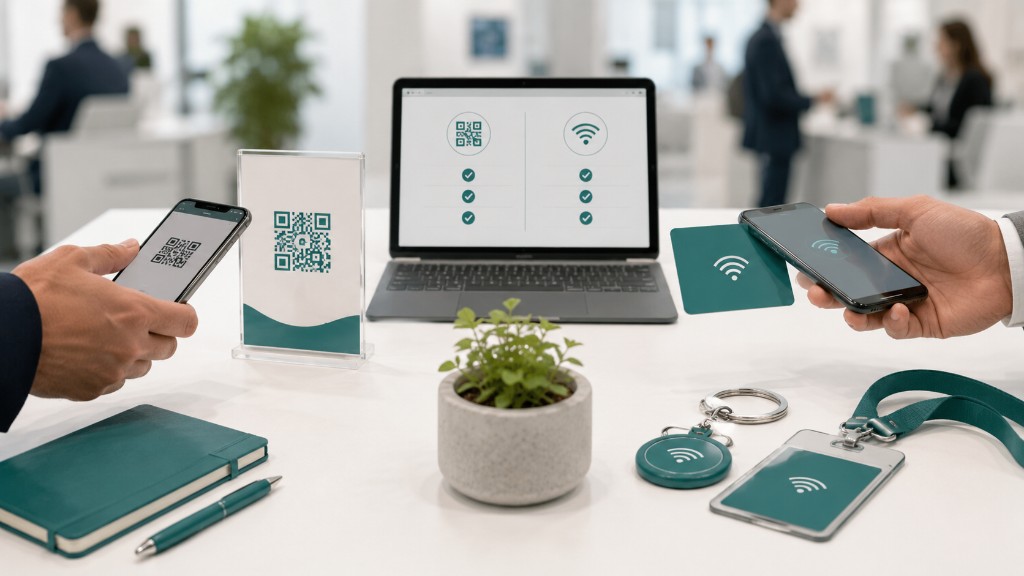
The QR code and NFC have the same objective: trigger a digital action upon contact with a physical object. But they do not create the same experience, do not lend themselves to the same uses and are not used in the same contexts.
B2B best practice: combine the two. NFC for premium fluidity, QR for maximum compatibility.
Quick comparison
Each technology has its strengths. Here is the decision table.
| Criterion | QR code | NFC |
|---|---|---|
| User gesture | Frame + scan | Approach the phone |
| Compatibility | Universal | Very good (recent smartphones) |
| Visual discretion | Visible | Unseen |
| Perception | Standard | Premium and modern |
| Integration cost | Very weak | Slightly higher |
| Remote editable | Yes (dynamic URL) | Yes |
When to choose the QR code
Favor QR on general public printed media, posters, packaging, flyers or when your target is not equipped with a recent smartphone. Zero marginal cost to integrate.
When to choose NFC
Choose NFC for premium items, business cards, B2B media, retail and face-to-face experiences. The gesture is more fluid, more modern, more memorable.
In B2B, NFC promotes your brand as tech-forward and committed to the experience.
The golden rule: combine the two
On most Timelapse-3D media, both are integrated: NFC for equipped users, QR as a safety net. You maximize conversion without losing part of your audience.
Are you hesitant about NFC or QR?
We configure both on the same support and let you measure the performance. No commitment.
FAQ
Does NFC work on all iPhones?
On all iPhones since the XS (iOS 13). For earlier models, the QR code takes over.
Does a dynamic QR code cost more?
When printed, no, but the dynamic URL goes through a service. The cost remains much lower than NFC for massive volumes.
Is NFC secure?
Yes, the chip only transmits an URL. No personal data is read or sent by the tag.