
“Cheap” is one of the most sought-after criteria for promotional items. And it’s understandable: when you distribute several thousand media, every tenth of a euro weighs heavily in the final bill. But reducing the choice to unit price alone means depriving yourself of part of the value. The cheapest can be expensive if the object is thrown away immediately, if it damages the brand image or if it does not generate any measurable action.
This guide helps to think differently: not in price per object, but in cost per useful interaction. A $1 goodie that generates a scan, a lead or a Google review can be much more profitable than a $0.30 goodie that ends up in the trash can in the hall. The good inexpensive object is the one that combines affordability, sufficient quality for the brand and the ability to trigger something.
Why look for cheap promotional items?
The reasons are legitimate. When the marketing budget is tight, when the volume is high, when the operation is one-off or when the target is very large, the unit price becomes a structuring factor. Five contexts come up often.
- Limited marketing budget, particularly for SMEs and young structures.
- Volume distribution at a trade show or general public event.
- Product launch with need to occupy the ground quickly.
- Field prospecting by a sales force which distributes every day.
- Commercial animation or one-off promotional operation.
The lowest price trap
When we only optimize the unit price, we almost mechanically import the defects of low-cost. Here are the consequences observed in real life, on well-intentioned campaigns.
- Poor quality: fragile material, rough finishes, rapid aging.
- Poor visual rendering: dull colors, sloppy printing, illegible logo.
- Object thrown away immediately: too visibly low-end to be worth keeping.
- Bad image reflected: a sloppy goodie suggests a sloppy business.
- Lack of conservation: marginal use, very short exposure time.
- No measurable return: no scanning possible, therefore no calculable ROI.
How to choose an economical but effective promotional item?
There is a zone of balance: controlled price, sufficient quality, real utility, capacity to measure. Here's a simple seven-step method to find it.
- Start from use: the object must serve something in the target’s daily life.
- Keep it simple: a standard format costs much less than a custom creation.
- Aim for a minimum acceptable quality: no materials that break or deteriorate quickly.
- Adapt to the target: what works for a general audience does not work for a premium client.
- Provide a CTA: an inexpensive object can still lead to a measurable action.
- Create a landing page: this is often where the conversion takes place, not on the object itself.
- Measure results: without tracking scans, it is impossible to optimize the next campaign.
Accessible objects that can work well
Several supports remain compatible with a tight budget while maintaining a realmarketing potential. Here are the ones that come up most often in our “controlled budget” quotes.
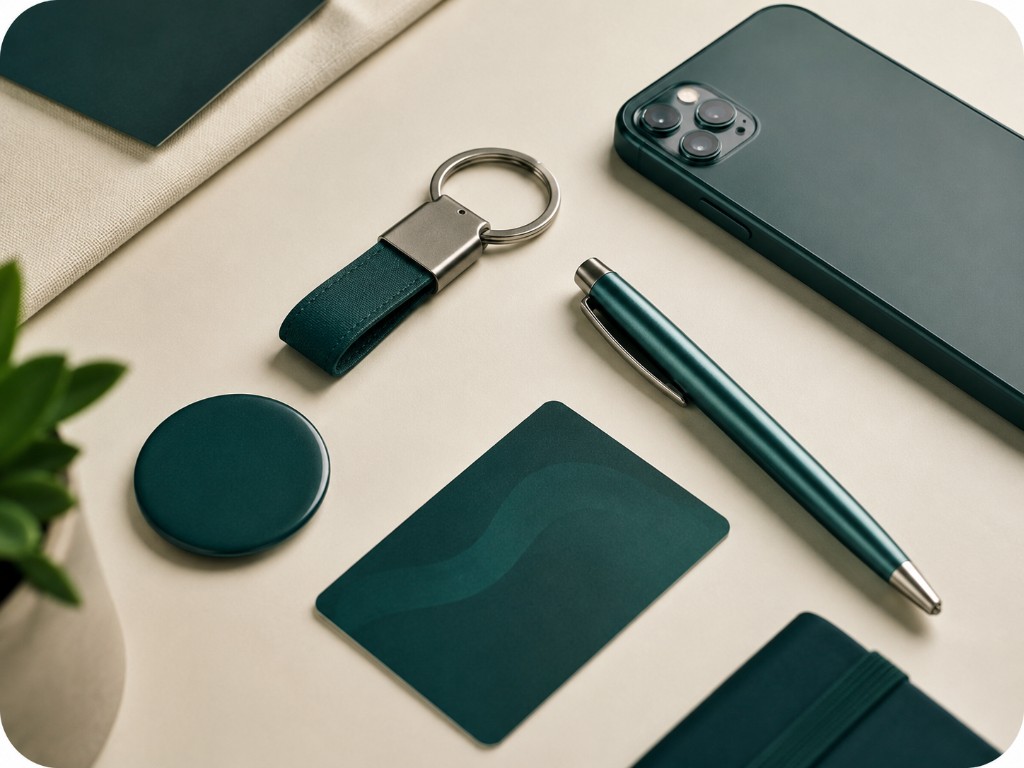
- NFC magnet: durable, kept for a long time, affordable price in volume.
- Simple NFC badge: ideal for events and mass distribution.
- Entry-level NFC key ring: long shelf life, modifiable link.
- Simple NFC card: standard format, few finishes, perfect for volume networking.
- Basic NFC plate: simple version for businesses with a small communications budget.
- Connected pen: depending on the volume, can remain very accessible with real use value.
Why a connected object can be more profitable
An NFC item generally costs a little more than an equivalent basic goodie. But this differential pays off as soon as the object triggers measurable actions. This is the whole meaning of the “cost per useful interaction” rather than “unit cost” reasoning.
Concretely, a connected object can generate scans, leads, Google reviews, completed forms, quote requests, registrations for a sponsorship program, conversions to a purchase. Where a classic goodie remains silent, the connected object becomes a complete acquisition channel. And each measured action can be compared to its acquisition cost.
How to calculate the ROI of a campaign?
The principle is simple: compare the total cost of the campaign (production, personalization, logistics, landing page, configuration, monitoring) to the actions generated and the business value of each. The generic formula is in one line: ROI = (value of actions generated – total cost) / total cost.
Without promising a specific result, the typical example speaks for itself. A campaign of 1,000 connected objects that generates scans, quote requests or customer reviews often becomes more profitable than a distribution of 3,000 non-measurable objects. You may never know what the second reported, you will know exactly what the first reported.
For complex campaigns, it is useful to think in several KPIs: cost per scan, cost per qualified lead, cost per Google review, cost per appointment made. This segmentation makes it possible to identify what works, adjust the most effective supports and eliminate what produces nothing.
Mistakes to avoid
Five mistakes come up again and again in “tight budget” campaigns. Anticipating them avoids wasting the investment, however modest it may be.
- Choosing solely on price: this is the founding error which contaminates the entire campaign.
- Neglecting quality: a visibly low-end item is not worth keeping.
- Forget branding: A sloppy goodie suggests a careless company.
- Do not plan any action: without a CTA after receipt, the support remains passive.
- Do not follow the results: without measurement, you will make the same choices by default.
Create accessible, personalized and measurable promotional items
Timelapse-3D helps you find the right balance of price/quality/measurement to turn a tight budget into a truly profitable campaign.
FAQ
What is the cheapest promotional item?
NFC stickers, simple NFC cards and pens remain among the most accessible options, especially in volume. The cheapest rarely remains the most profitable: the real useful unit of measurement is the cost per interaction.
How to choose inexpensive goodies?
Start from the use and the target, choose a standard format, check a minimum acceptable quality, plan a CTA after scanning and prepare a clear landing page. That’s where the conversion comes into play, not in the penny earned on the item.
Are cheap promotional items effective?
They can be so provided they are useful, sufficiently qualitative to be preserved and linked to measurable action. Without these three conditions, low-cost is a loss.image and in total absence of ROI.
What budget should you plan?
Rather than aiming for an absolute unit price, think in terms of cost per useful interaction. A $2 NFC magnet that generates a Google review and a reservation can be much more profitable than a $0.30 pen that is never used.
How to measure profitability?
By tracking scans, leads, Google reviews and conversions generated by connected objects. Compare the total cost of the campaign (production + landing + tracking) to the business value of the actions triggered.
What inexpensive object to choose for a living room?
An NFC magnet, a simple NFC badge or an entry-level NFC card. These supports remain accessible in volume while making it possible to capture a qualified lead with each scan, with a trade show and commercial context.