
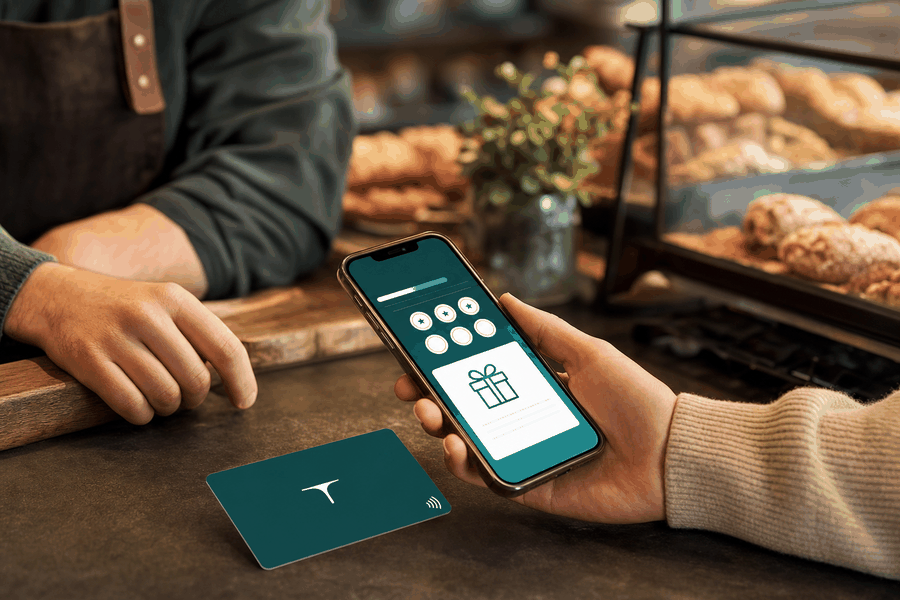
Customer retention remains the most profitable lever in local retail: selling to an existing customer costs several times less than acquiring a new one. Yet the dominant tool is still the stamp card — anonymous, easily lost, impossible to measure.
The NFC loyalty card changes the equation: the customer taps their phone at the till, their loyalty account opens, their points accumulate, and you finally capture the data that was missing: who comes back, how often, and what makes them return.
How does an NFC loyalty card work?
The medium (card, keyring, sticker at the till) contains an NFC chip. On scanning, the customer reaches their web-based loyalty area — no app to download, no tedious account creation: a first name and a phone number are enough on the first visit.
The retailer validates the visit (digital stamp, points, tiers) from their own screen. Everything is web-based: compatible with iPhone and Android, up and running in minutes per point of sale.
Stamp card, mobile app, NFC: the comparison
Each solution has its strengths — but the NFC card combines the simplicity of the physical with the data of the digital, without the friction of an app to install.
| Criterion | Stamp card | Mobile app | NFC card / medium |
|---|---|---|---|
| Customer friction | Low but card gets forgotten | High (download, account) | Very low (one tap) |
| Data collected | None | Rich but costly | Rich and automatic |
| Setup cost | Almost nil | High (development, maintenance) | Moderate (media + platform) |
| Marketing follow-up | Impossible | Push often ignored | Email / SMS targeted on behaviour |
The scenarios that work in retail and food service
The programme must be understandable in 3 seconds: "10 visits = 1 free" remains unbeatable. The NFC mechanics then let you go further without complicating the experience.
- Bakery / café: NFC sticker at the till, visits accumulate, reward on the 10th
- Restaurant: NFC card handed over with the bill, points plus a Google review flow combined
- Shop: NFC loyalty keyring — the promotional item and the card merge into one
- Hair salon / beauty institute: automatic appointment reminder at the right interval
- Multi-shop network: shared programme, statistics per point of sale
The data: what the stamp card will never tell you
Every scan feeds the Timelapse-3D back office: visit frequency, dormant customers, peak hours, return rate after an offer. You move from blind loyalty to precise management.
Follow-ups become surgical: a customer absent for 30 days automatically receives an SMS with a comeback offer; a loyal customer is invited to refer a friend. It is scoring and automation applied to local retail.
How much does it cost and where do you start?
The starter setup is light: NFC cards or keyrings (from $1 to $3 apiece depending on the medium), an NFC sticker at the till, and access to the loyalty platform. A point of sale is operational in less than a day.
Start with a simple programme at a single point of sale, measure for 2 months, then expand: the data collected will tell you exactly which reward and which follow-up rhythm work for your customer base.
Launch your NFC loyalty programme
Timelapse-3D supplies the media (cards, keyrings, stickers), the loyalty platform and the automated follow-ups. Operational in a few days.
FAQ
Does an NFC loyalty card require an app?
No. The customer scans the card or medium with their smartphone and their loyalty area opens in the browser. No download, compatible with iPhone and Android.
What happens if the customer loses their card?
Their loyalty account is online, linked to their phone number: a new card is re-associated in seconds, with no loss of points — unlike the stamp card.
How much does an NFC loyalty card cost?
The medium runs $1 to $3 apiece depending on the format (card, keyring, sticker), plus the subscription to the loyalty platform. A shop can start for a budget far below the cost of developing an app.
What data does the retailer collect?
Visit frequency and times, active and dormant customers, offer effectiveness, return rate after a follow-up — all viewable per point of sale in the Timelapse-3D back office.